Table of Contents
We Deleted Docker (and the Flakes Too)

Not the images. The Dockerfiles. All 14 of them.
The old setup ran Nix inside Docker. A nixos container per service, bind-mounting the repo, each with its own private Nix store volume. We were paying container tax to run a build system whose whole point is not needing containers. Peak cosplay.
Last time we flaked the website and went 19→5 minutes. This time we went further and deleted the flakes too. Classic Nix: default.nix, release.nix, shell.nix. Inputs pinned with nixtamal — a plain KDL manifest, evaluable by any Nix since forever. Docker images are just derivations:
nix-build release.nix -A images.websocket-server | docker loadThe Dockerfile never comes back. macOS cross-compiles aarch64-musl natively — no VM, no Linux builder. Your laptop emits ELF.
Why kill flakes?
Because flakes are not Nix. They're a framework bolted onto Nix, and after eight years the bolt is still marked experimental — every command starts with a flag ritual acknowledging you're off the supported path. And what does the framework buy you? Rigidity. The inputs block is a dead mini-DSL: you can't type real Nix in it — no functions, no conditionals, no computing an input from another input. It's a config file cosplaying as a programming language, inside a programming language. Then the evaluator copies your whole repo into the store on every eval to enforce a purity you already had.
Classic Nix is just a language. default.nix is a function; you call it with import, compose it, override it, parameterize it — the full language, everywhere, including the pins. The one thing flakes genuinely gave us — a lockfile — nixtamal provides in ~40 lines of KDL without taking the language away. Stability, power, and the lock. Pick three.
The scoreboard
| before | after | |
|---|---|---|
| Dockerfiles | 14 | 0 |
| flakes | 1 | 0 |
| containers in the dev loop | all of them | 0 |
| CI image gate, wall clock | ~10:00 (worst leg 22:00) | 5:05 |
| dioxus-ui browser test job | 13:19 | 2:21 |
79 files, +3540/−1844. Dev is process-compose now: postgres 18, NATS, prometheus, grafana and every server under cargo-watch — native processes, health-gated startup, zero Docker on the hot path. Integration tests spin a throwaway native stack. Env layering is defaults < .env < .env.local, last one gitignored.
Numbers, because everything else is marketing
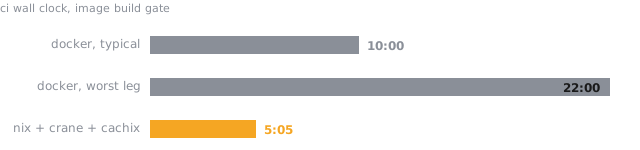
The trick isn't Nix, it's caching done honestly. crane splits dependency compilation into its own derivation whose hash ignores source churn — verified at the unit level: the same web-sys unit hash across commits, or you don't have a cache, you have a vibe. Cachix serves it back to all 13 CI jobs. Dependencies of dependencies compile once, ever.
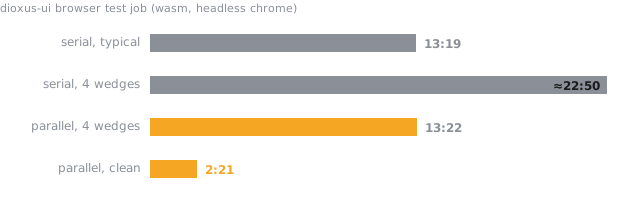
Headless Chrome sometimes wedges its renderer at session startup for exactly 300 seconds. The browser tests ran serially, so one wedged renderer blocked the line for 5 minutes, about twice per run. We don't fight the timeout — we overlap it: prebuild every test binary once, then drive wasm-bindgen-test-runner directly, 3 sessions at a time. You can't get this through cargo test — parallel invocations serialize on the target-dir lock and your parallelism is fake. Clean run: 2:21. The worst measured run had four wedges and still matched the old baseline's best day.
Lessons
- If your build needs a Dockerfile, your build has state you haven't admitted to. Derivations force the confession.
- Measure the cache at the derivation-hash level or you don't have a cache, you have a vibe.
- The 300-second timeout was never the bug. The serialism was.
17/17 e2e green. All numbers from CI logs on PR #897.